
From Physiology to Programming: How I Actually Train Runners
Mass Doesn't Fly But Neurological Adaptations Do: Strength For Runners

From Physiology to Programming: How I Actually Train Runners
When it comes to programming and periodization for athletes, the most challenging question that comes up is "Who did you get that from?" or "What is that based on?"
It's a fair question. In a field where every coach has the "secret sauce" and every methodology claims to be revolutionary, people want to know where your ideas come from. They want the pedigree that validates your approach.
But here's what makes this question both fascinating and frustrating: for me, everything is a combination of my education and experience from the years prior. Combining ideas from my first two newsletter issues - cognitive connections and evidence-based practice - everything I've been exposed to, the experiences I've had, and catering toward the values of those I've worked with have melded together to create my own programming philosophy.
It's difficult to describe. It's like trying to explain how you learned to speak your native language. Sure, you had teachers and formal instruction, but the real fluency came from thousands of conversations, countless mistakes, and gradual refinement over years of practice.
When someone asks me to cite my programming philosophy, I can't point to a single source and say "that's it." Instead, I have to walk them through a journey that started with a confused coach trying to figure out why his cross country runners wouldn't show up to the weight room, and evolved into a systematic approach I've now applied to nearly a hundred endurance athletes.
But in the interest of you, the reader, I'll do my best to break it down.
The lens I'll look through is where I've been, then what I've done, and where I'm going as it relates to creating the best, physiologically sound strength training programs for runners. Think of it as reverse-engineering my own thought process to show you not just what I do, but why I do it.
In consideration for your time and my sanity, I'll keep these components fixed to how they specifically apply to my philosophy toward training the running athlete. Though lots of them meld over into my training philosophy as a whole. At the end of the day, principles and foundational concepts are few and mostly stay the same, but strategies are abundant.
Good programming isn't about having the most innovative exercises or complex periodization scheme. It's about consistently applying sound principles while remaining flexible enough to adapt to the individual athlete in front of you. The science gives you the framework, but the art comes from knowing when and how to apply it.
This philosophy didn't develop overnight. It's been shaped by mentors who challenged my thinking, athletes who responded in unexpected ways, research that forced me to reconsider beliefs, and failures that taught me more than any success.
The Foundation: People and Places
Let me walk you through the two pillars that have shaped how I think about training runners: the human influences and the environmental factors that have each played a crucial role in developing my approach.
People: The Minds That Shaped Mine
Some of my biggest influences from a programming standpoint have been Dr. Mike Stone, Dr. Brad DeWeese, Charlie Francis, James Smith, Alex Natera, James Wild, Cal Dietz, Vic Brown, and Jonah Rosner. What's important isn't just that these people are smart, it's that each brought something different while sharing one trait: an obsession with making training more effective, not just harder.
Dr. Mike Stone — foundational periodization, training theory, and athlete adaptation. His work fundamentally changed how I think about how different stresses interact and compound over time.
Dr. Brad DeWeese — sequential integration periodization and holistic programming. This approach to systematically building adaptations while managing fatigue has become central to how I structure training phases.
Charlie Francis — high-low sequencing and respecting the nervous system. His insights into nervous system management have influenced how I structure training weeks and think about recovery.
James Smith — systems thinking and first principles-based coaching. This approach taught me to always ask "why" and build programs from fundamental principles rather than copying what others do.
James Wild — sprint and strength integration for sprinting/running athletes. His work bridging the gap between pure strength and running-specific power has been invaluable for my endurance athletes.
Cal Dietz — stress adaptation, specific strategies, triphasic training, and eccentric/isometric emphasis. His systematic approach to strength development phases has influenced how I think about progressive overload.
Vic Brown — teaching clarity, consistency, and simplicity in programming. Perhaps most importantly, he showed me that the best programs are often the simplest ones executed consistently.
Alex Natera — run specific isometrics and training organization. His work on isometric applications for runners opened my eyes to how position-specific strength work can enhance running economy.
Jonah Rosner — one of the most innovative minds I've worked with in turning complex science into applied training strategies. Our conversations have pushed me to be more precise and rigorous in my thinking while staying grounded in current research.
The key insight from studying all these approaches: the best coaches aren't those who blindly follow one methodology. They're the ones who understand the underlying principles well enough to adapt them to their specific context and athletes.
Places: Where Theory Met Reality
What I've learned at each stop has been crucial, but not always in expected ways.
Ithaca College is where I first put my knowledge into practice with those cross country teams I mentioned last week. This is where I learned that all the theory in the world doesn't matter if your athletes don't buy in. Programming isn't just about sets and reps - it's about creating an environment where athletes want to get better.
The lesson from Ithaca wasn't just about methodology. It was about meeting athletes where they are, both physically and psychologically. That men's team that started with 40% attendance taught me that the best program on paper is worthless if nobody executes it consistently.
RPI is where I got to whittle it down to what mattered most - no fluff, just results. With one 30 minute session per week this is where I developed my "minimum effective dose" philosophy - finding the smallest training stress that produces maximum adaptation.
The engineering mindset at RPI influenced how I think about programming. These athletes thought systematically about problems and expected their training to be equally systematic. Everything needed clear purpose and logical progression.
Zepp Health is where I refined it down to component parts and understood the why behind every decision. Working with world class coders and computer programmers to develop a systematic approach to dynamic strength training prescription, I had to clarify my thinking and refine my processes to a whole new level.
More importantly, Zepp taught me about scalability. Creating an effective program for athletes you see daily is one thing. Developing principles that work across different populations, training ages, contexts, all around the world, virtually is entirely different.
All of this experience - the people who shaped my thinking and the places where I learned to apply it - led me to a simple realization: the best programming frameworks are the ones that work in the real world, not just on paper.
Complexity Redefined:
Though diving into my periodization and programming philosophy for runners can be quite lengthy and complex, I'll speak to you through two lenses:
"It is laziness to not compress your thoughts" - Winston Churchill
"If you can't explain it simply, you don't understand it well enough" - Albert Einstein
Though commonplace in our field to start with a well-defined annual plan and work down through the macro, meso, and micro, I prefer to take a page from the distinctly similar field of product management and use terminology similar to that of Agile Periodization by Mladen Jovanović, where he uses the terms release, phase, and sprint. Fixing it for myself, I prefer:
Cycle – the full training builds toward a race or peak season. Think of this like your “Macrocycle.”
Phase – a focused block of training targeting a specific adaptation (max strength, tendon stiffness, etc.), the “Mesocycle.”
Sprint – the week-to-week chunk where things either work or don’t. This is where real training lives. The “Microcycle.”
Simple. Clear. Athlete-first.
I’m not trying to rename the wheel, just making it turn smoother.
Cycle: The Big Picture View
Starting with the cycle, it is the most simplistic component. This is periodization. We must understand three key concepts and then build upon them:
Where is the athlete now?
Where are they going?
How do we get there?
That's it. Everything else is just noise.
Where is the athlete now? This isn't just about current fitness or strength numbers. It's about training history, injury background, time constraints, psychological readiness, and what adaptations they've already banked. A seasoned marathoner coming off a training block is in a completely different place than a high school runner starting their first strength program, even if their squat numbers are similar.
Where are they going? This seems obvious but gets overlooked constantly. Are we preparing for a 5K PR in 12 weeks? Building base for a marathon cycle starting in 6 months? Getting ready for cross country season? The destination determines everything about the route we take.
How do we get there? This is where art meets science. It's about understanding what adaptations need to happen in what order, how much time we have, what other training demands exist, and how to sequence everything so each phase builds logically toward the next.
The beauty of thinking in cycles is that it forces you to be honest about timelines and realistic about what's achievable. You can't cram a year's worth of adaptations into 8 weeks, but you can absolutely optimize what happens in those 8 weeks if you're clear about your starting point and destination.
These include a strategic combination of phases that build upon each other. You can't build Rome in a day, nor can you push the needle on every specific adaptation in one specific phase. Taking from the concept of sequential integration periodization, each block builds on the previous one, all towards the final goal. More on this in the next section.
Cycle Considerations:
General to specific stress - special emphasis should be placed on pairing training goals on the track/trail with those in the weight room. Understand what the goal of the runner or their coach is so you can help amplify the signal rather than just turn up the noise.
Taper - Know when the athlete/team is going to taper. You, the runner, and the coach are in the same boat. To go in a straight line, you all need to be paddling in the same direction. If you are pushing while the coach is pulling back, you will be going in circles.
Focus at this point should be on the minimal effective dose and fatigue mitigation. We should maintain pre-taper intensity while reducing volume by 30-60%. Effort should be placed on refining the old rather than exposing to the new. This means, choose exercises the athlete is used to and manipulate them to have the least physiological cost possible.
Phase: The Building Blocks
Understand where you are and what you are looking to achieve. This is where I lean on the emphasis approach to training, commonly referred to as vertical integration periodization, developed by Charlie Francis.
"If it is important at the end of the program, then it should be present in some capacity at the beginning" – Charlie Francis
A training method where multiple physical attributes (speed, power, endurance) are developed concurrently, but with varying levels of emphasis depending on the phase.
These phases are organized in my head into a few primary ones:
Acquisition: A low-intensity, foundational phase focused on building a base level of fitness and movement competency in preparation for more intense training.
Accumulation: A volume-focused phase where volume is progressively increased, focusing on enhancing work capacity and muscular endurance for the targeted physical quality.
Intensification: An intensity-focused phase that emphasizes increased training intensity, with a focus on improving strength and power for the targeted physical quality.
Realization: The peak training phase is designed to express the developed strength, power, or speed adaptations concerning the emphasized physical quality.
Taper: A strategic manipulation of variables (volume) to minimize fatigue and maximize performance going into critical periods.
The above are just organizational building blocks - what you name them, or how you define them, is up to you. Remember:
"With endless programming possibilities, your role is to refine and distill these options into the most effective program that meets your athletes' specific needs." - Me
Example Organizational Structure:
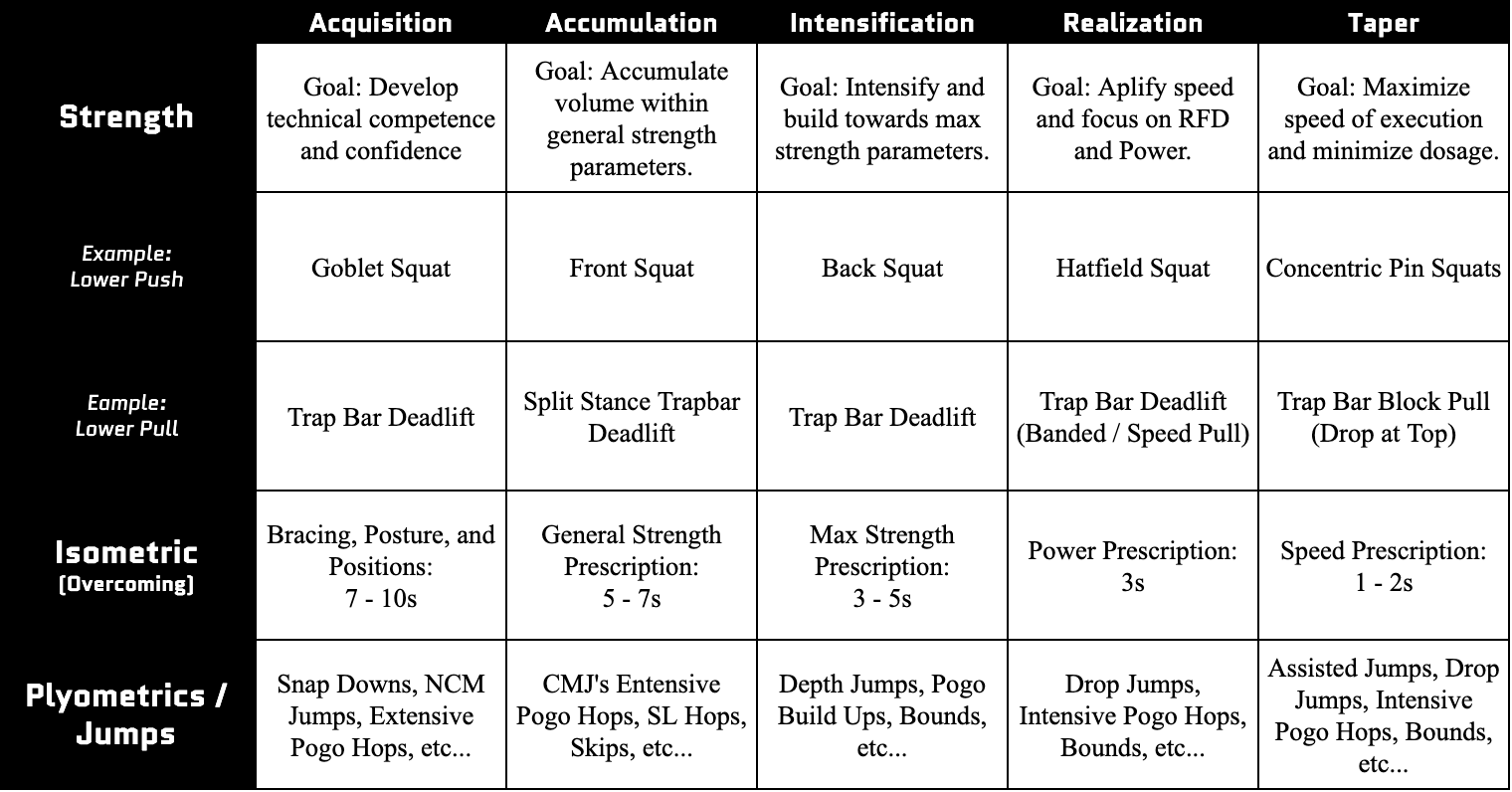
The above is just a quick, perfect world example. Remember who you are working with. What might work for a highly trained runner with years of experience in the weight room is not going to work for all of your runners. Even those at the top of the game might be true beginners in the weight room. Fit your programming accordingly.
Phase Considerations:
Is my programming working? - Don’t leave this question unanswered until race day. Similar to a product team delivering an MVP (minimal viable product) or proof of concept before the actual product release, you want to know if your programming is doing what it is supposed to. This means you should have a testing/monitoring strategy built into your system - if you want to know what this looks like for me, shoot me a DM!
Sprint: Where Theory and Planning Meet Reality
This is where the magic happens - and if not organized correctly, where most programs fall apart. The sprint is your weekly microcycle, the 7-day chunk where all your planning either works or doesn't. It's where you translate cycles and phases into actual training sessions that fit into real athletes' lives.
The sprint is about three things: timing, communication, and adaptation.
Weekly Structure Philosophy
My approach to organizing the 7-day microcycle is brutally simple: support the running, don't compete with it. This is "complementary loading" - when running intensity is high, strength training intensity can be high, but volume stays low. When running volume is high, strength training focuses on movement quality and maintenance.
Most weeks follow a high-low pattern borrowed from Charlie Francis. Hard days are hard, easy days are easy, and there's no in-between. From here, I created a simple set of rules:
Speed / Interval / High Intensity Days: We Lift
Easy Runs or Long Runs: We Don't
Don't lift before a long run, and don't waste an easy day by smashing your legs in the weight room.
The key insight: Survive your high-intensity days and take your easy days seriously. "Don't let today ruin tomorrow." - Tony Hollar.
Session Timing and Integration
In the world of running, the schedule dictates everything. Though timing matters more than most coaches realize, the perfect situation rarely exists. Here are my easy-to-follow rules:
Separate the sessions when possible (3-4+ Hours ideally). Run early and then lift later.
Lift immediately after the run if needed (grab a snack and finish strong). Focus on the main rocks and avoid fluff.
It is important to be consistently good rather than occasionally great. If the schedule doesn't match the ideal scenario then make the best with what you have.
Special Considerations: Everyone has different goals. If you are looking to maximize hypertrophy (first off, lots of miles might not be the best idea), then scheduling your lifts and runs separately is not just ideal, it's physiology. Not to go too deep into the physiology, we will consider two main adaptation pathways:
AMPK (AMP-activated protein kinase): Activated primarily by endurance training, this pathway promotes mitochondrial biogenesis, fat oxidation, and cellular energy efficiency. It's your body's "endurance mode" - optimizing for sustained energy production and metabolic efficiency.
mTOR (mechanistic target of rapamycin): Activated primarily by resistance training, this pathway promotes protein synthesis, muscle growth, and cellular building processes. It's your body's "growth mode" - optimizing for tissue repair and hypertrophy.
Here's the key: these pathways can interfere with each other when activated simultaneously. AMPK activation from endurance work can actually inhibit mTOR signaling, which is why concurrent training typically results in smaller muscle mass gains compared to strength training alone (not always the case, though). For runners, this interference effect is actually beneficial - you get the strength adaptations without the metabolic cost of carrying extra muscle mass.
This is why same-day training order and timing matter. If your primary goal is running performance, this pathway interference works in your favor, helping you build strength without bulk.
Auto-Regulation Strategies
This is where the art happens. Every athlete walks in the door differently each day, and rigid programming breaks when it meets human reality.
I use simple indicators: subjective questionnaires and jump monitoring when available. Though the fancy technology is awesome, so is just talking to the athlete (Thats coming from a sports science nerd).
The program gives you the framework, but the athlete in front of you determines the execution. Sometimes "prescribed" becomes "suggested," and that's exactly how it should be.
Communication and Load Management
Here's where most strength coaches fail with endurance athletes: they program in isolation. I'm in constant communication with running coaches. I know when the hard weeks are coming, when races are scheduled, and when athletes are struggling.
Weekly check-ins cover three things: how the running is going, how the strength sessions felt, and what's coming up. If I know there's a 20-mile run on Saturday, Friday's strength session becomes movement prep, not a strength builder.
Load management is about seeing the forest, not just the trees. Some weeks we push, some weeks we maintain, and some weeks we just keep the movement patterns alive while the running takes priority.
The sprint section is where your periodization philosophy meets the chaos of real life. Stay flexible, communicate constantly, and remember - the best session is the one that sets up tomorrow's training to be better.
Conclusion: Stop Making Excuses, Start Making Progress
The physiology we discussed last week tells us why strength training works for runners - those neural adaptations, structural improvements, and enhanced running economy are real, measurable, and achievable. What I've outlined here is how I systematically apply that knowledge to get results.
From the big picture cycle planning down to the daily sprint decisions, this framework gives you a roadmap for integrating strength training that actually enhances running performance rather than competing with it. The cycle forces honesty about timelines and destinations. The phases provide systematic progression through adaptations. The sprint handles the week-to-week reality of making it all work with real athletes and real constraints.
This isn't about having the perfect program. It's about understanding principles well enough to adapt them to the athlete in front of you. Your high school cross country runner needs a different implementation than your master’s marathoner, but the underlying concepts remain the same: build progressively, emphasize what matters most for each phase, communicate relentlessly with running coaches, and always keep the end goal in sight.
But here's what matters most: none of this works if you don't start. I've seen too many coaches get paralyzed trying to create the "perfect" program while their athletes continue leaving free speed on the table. The difference between a good program executed consistently and a perfect program that never gets implemented is everything.
Your athletes don't need you to reinvent periodization. They need you to understand it well enough to apply it intelligently, adjust it based on their responses, and execute it with the kind of consistency that builds champions.
The science gave us the why. This framework gives you the how. Now it's time to get to work.
This is next level!
great stuff Alex! I've certainly come to the conclusion that lifting on hard days for my athletes is the best approach.